5 UPF Checks Before an Autumn Hiking Day
Quick Answer: Autumn sun burns people because UV does not track temperature. At altitude UV intensity rises roughly 10-12% per 1,000m, the sun sits lower so your face and neck take more direct angle, and cool air removes the discomfort cue that normally makes you cover up. Five checks: shirt stretch, wet-fabric gap, neck and ear coverage, hand exposure, and the reflective surfaces you’ll be walking on.
Cool air. Low sun. Long day out.
Every autumn burn happens for the same reason: it did not feel like a sun day.
Check 1: Is your shirt still doing its job when stretched?
Stretch the fabric over your hand and hold it to the light. If you can see daylight clearly through it, the UPF rating on the label no longer applies to that garment in use.
This matters because UPF is measured on relaxed fabric, and a hiking shirt spends the day stretched — across shoulders under a pack, over the back when you reach, at the elbows on a scramble. Stretched fabric has larger gaps between yarns, and UV goes straight through gaps.
The practical version: a shirt that fits loosely protects better than a technically identical shirt worn tight, because the loose one never stretches. This is the opposite of what most people assume, and it is the single biggest coverage gap in the average hiking wardrobe.
Older garments compound it. Elastane degrades, knits relax, and a five-year-old sun shirt that has been through a hundred washes and a lot of sun does not perform like it did new. If it has gone thin, baggy in a stretched-out way rather than a cut way, or noticeably lighter in colour, treat it as a normal shirt and plan sunscreen accordingly. Hold it to a window before a big day — the check takes ten seconds and it is the most informative one on this list.
Check 2: What happens to that fabric when it gets wet?
Wet fabric can lose a substantial share of its UV protection, and autumn hiking is wet more often than summer hiking — dew on early starts, river crossings, sweat under a pack, and rain that arrives without much warning.
Water fills the air gaps in the weave and changes how light scatters through it, so more UV reaches skin. The effect is largest on lightweight cotton and thin single-layer knits, and much smaller on tightly woven synthetics designed for sun protection.
Three things this changes about your packing.
First, the back panel under your pack is the highest-risk area, because it is where sweat concentrates and where the fabric is pressed and stretched at the same time. A shirt that stays dry there is worth more than one with a marginally higher rating.
Second, carry a dry spare for a long day out, particularly if the route has an exposed section in the afternoon. Changing into a dry shirt at lunch is a sun measure as well as a comfort one.
Third, quick-dry synthetics outperform cotton twice over here — better wet protection, and less time spent wet. If you are choosing one shirt for an exposed autumn ridge day, this is the deciding factor.
Check 3: Are your neck, ears and jawline actually covered?
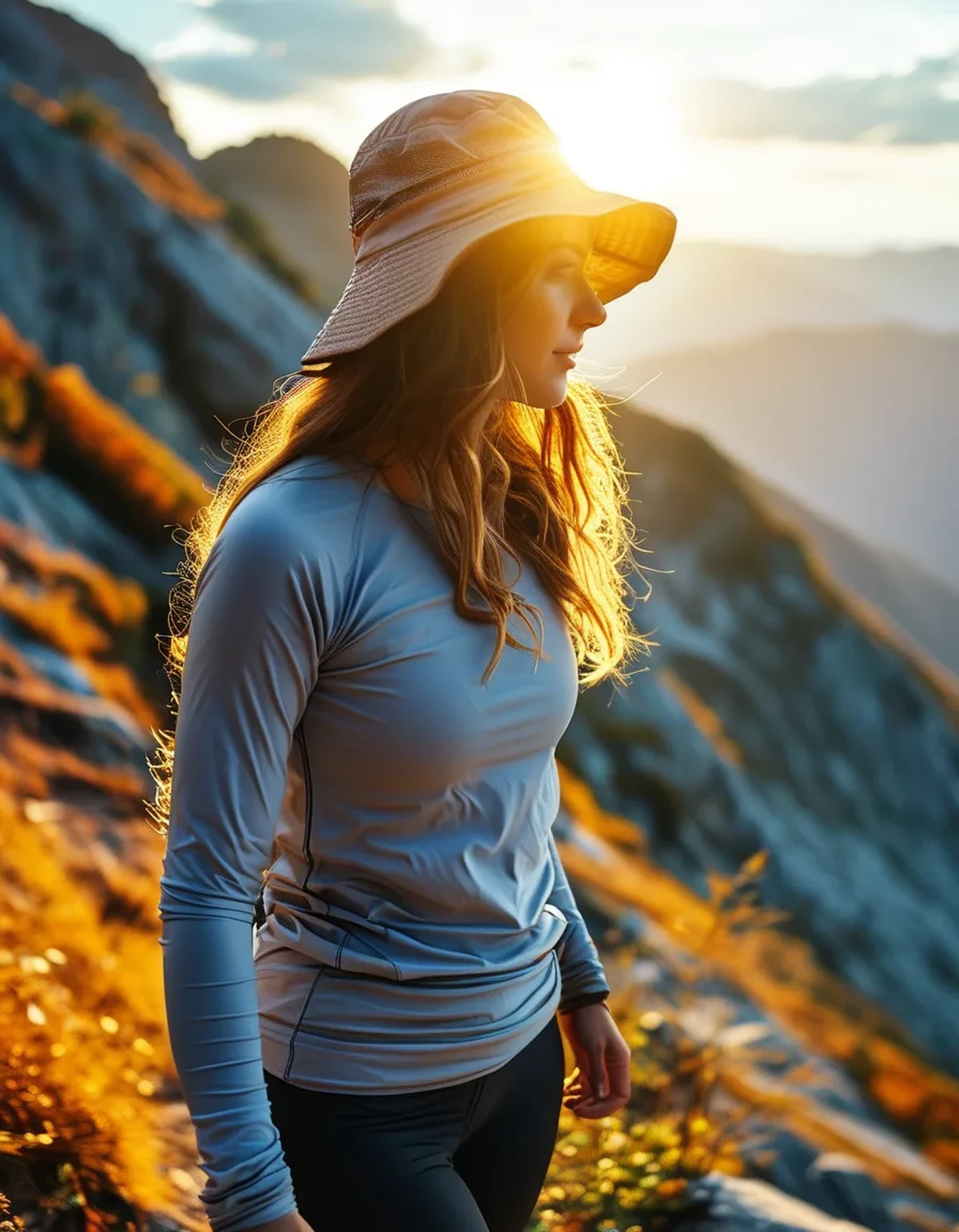
The low autumn sun changes the geometry of your exposure completely, and hats designed for summer stop working.
A cap protects against overhead sun. In October the sun sits far lower for much of the day, coming in at an angle that goes straight under a cap brim onto your face, jaw, ears and the front of your neck. That is why the classic autumn burn pattern is a stripe under the chin and across the ears rather than the top of the nose.
Three coverage fixes, in order of how much they close.
A wide brim all the way round rather than a forward-only cap. It handles the lateral angle a cap cannot.
Ears specifically. They are among the most commonly missed spots and among the more common sites for sun damage over a lifetime. A cap leaves them fully exposed at low sun angles. A brim helps; a UPF neck gaiter pulled up over the ears covers them completely and doubles as warmth on a cold summit — which is exactly the kind of dual-purpose piece worth having in an autumn pack.
The back of the neck when you look down. Descending a technical trail means head-down for long stretches, which exposes a strip below the hairline that a collar normally covers. A gaiter or a legionnaire-style flap solves it, and nothing else really does.
Check 4: Have you thought about your hands?
Hands take significant cumulative sun exposure and almost never get protected, and autumn hiking makes it worse rather than better.
On a trail your hands are out in front of you, often at an angle that catches the low sun directly. Add trekking poles and the backs of both hands face upward and forward for hours at a time, with the wrist gap between glove and sleeve fully exposed on every pole plant.
Four fixes worth a minute of thought.
Sun gloves. Thin UPF fingerless gloves exist for exactly this and weigh nothing. They also add grip on cold poles, which is a genuine autumn benefit.
Longer cuffs, or thumbholes. A sleeve with a thumbhole covers the back of the hand and the wrist gap in one move, and it costs nothing extra when you are choosing a shirt.
Sunscreen on the backs of the hands, reapplied. This is the one people apply once and never again, despite hands being washed at every stream and wiped on trousers constantly. If you carry sunscreen, the backs of the hands should get it every time you stop.
And check your watch line. A watch or a fitness band leaves a hard tan edge because the skin under it is protected and the skin either side is not — a reliable sign you are getting more hand exposure than you thought.

Check 5: What are you going to be walking on and beside?
Reflected UV can add meaningfully to your total dose, and the surfaces that reflect most are exactly the ones autumn hiking puts you near.
Water reflects a substantial amount, so lakeside and river routes deliver UV to your face from below — under the brim of any hat, which is why hats alone never solve a water day. Early snow on high ground is the extreme case: fresh snow is highly reflective, and an early-season snowfield can more or less double your exposure while the air temperature says winter.
Light rock and scree reflect more than soil or forest floor. An exposed granite section, a pale limestone path, a wide gravel track — all bounce more back at you than the same distance through woodland.
Three planning moves that follow.
Look at the route profile for the exposed sections, and plan to have covered up before you get to them rather than when you notice the sun.
Treat altitude as a multiplier. UV rises roughly 10-12% per 1,000m of elevation, so a cool 1,800m ridge is a stronger UV environment than a warm valley floor, regardless of how it feels.
And remember cloud is not protection. A significant fraction of UV passes through light cloud, and thin high cloud can even scatter it in ways that increase exposure at ground level. Overcast is the most under-protected condition there is, because the discomfort cue disappears entirely.
This is general information, not medical advice — if you have a history of skin cancer or are on medication that increases photosensitivity, get personalised guidance from your doctor.
TL;DR:
- UV does not track temperature. Cool autumn air removes the cue that normally makes you cover up.
- Stretch-test your shirt against the light — loose fits protect better than tight ones, and old fabric protects less.
- Wet fabric protects less. Carry a dry spare for long exposed days; synthetics beat cotton twice over.
- Low sun goes under a cap. Full brim plus a gaiter over the ears closes the classic autumn burn pattern.
- Altitude adds roughly 10-12% UV per 1,000m, and water, pale rock and early snow reflect a real extra dose.
Run the five checks before your next big day out. Under five minutes, and it is the difference between a good ridge day and a burn you feel for a week.
Keep Reading
This article is for general informational and styling purposes only. Fit, sizing, and product availability may vary.