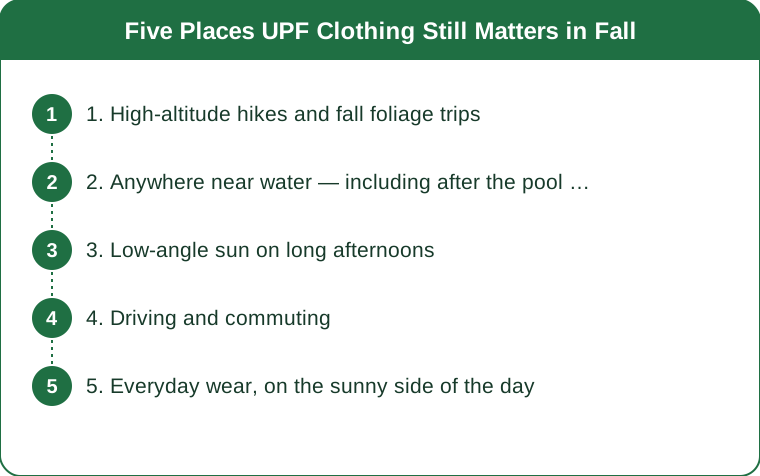
Five Places UPF Clothing Still Matters in Fall
Quick Answer: UVA stays high year-round and UVB, while lower in fall, is still meaningful at altitude, near water, and around midday. People stop protecting themselves in fall because the heat cue disappears — cool air reads as safe. Five situations where UPF fabric is still doing real work: high-altitude hikes, water, long low-angle sun, driving, and daily wear on the sunny side of the day.

1. High-altitude hikes and fall foliage trips
Altitude is the fall blind spot. UV exposure increases with elevation — commonly estimated at around 10 to 12 percent per 1,000 meters — because there is less atmosphere overhead to absorb it.
A fall hike is often a high-elevation activity, since that is where the color is. So you are gaining UV from altitude at exactly the time of year you have stopped thinking about sun. Add the fact that the leaves are off many trees, so the canopy that shaded the trail in July has thinned considerably.
A lightweight UPF 50 long-sleeve solves this without any temperature penalty, because a thin sun shirt in 55°F air is comfortable in a way it never is in August. Fall is actually the easiest season to wear full coverage.
2. Anywhere near water — including after the pool closes
Water reflects UV, and the reflection does not care about air temperature.
Open water can reflect a meaningful share of UV back at you, which effectively increases exposure from below — where sunscreen is most often missed and where clothing does not cover. Fall paddling, lake swims, early-season rowing and coastal walks all sit in this category.
The fall-specific factor is that people are still on the water while no longer treating it as a sun activity. A morning row in October in a short-sleeve top is a genuine exposure, particularly on the forearms and the back of the neck.
One thing to check on your existing gear: chlorine and salt degrade fabric over a season, and a UPF garment that has been through a summer of pool use may not be rating at what the label says. If the fabric has thinned or gone translucent when stretched, its protection has dropped.

3. Low-angle sun on long afternoons
This is the one nobody plans for. As the sun sits lower, it comes at you horizontally rather than from overhead.
That changes which parts of you are exposed. In summer the risk zones are the tops — shoulders, nose, part in your hair. In fall the sun hits the side of the face, the neck, and the forearms for hours at a time, and a hat brim designed for overhead sun does very little against it.
The practical consequence: a long fall afternoon outdoors — a game on the sideline, a walk, an outdoor lunch — delivers side-on exposure that a summer routine does not cover.
A collared sun shirt or a neck gaiter handles this better than any hat. For the face, this is where sunscreen and sunglasses matter most, since fabric cannot help you there and low sun is directly in your eyes.
4. Driving and commuting
Car windows are a genuinely overlooked exposure, and fall makes it worse rather than better.
Windshields block most UVB and a large share of UVA. Side windows typically block far less UVA, which is why dermatologists observe more sun damage on the driver’s side in many countries. And in fall, low sun sits directly in the side window for the entire morning and evening commute.
The left forearm and the left side of the neck are where this shows up over years. It is a slow, cumulative exposure that never feels like sun exposure, because you are in a cool car with the sun not feeling hot.
A lightweight UPF sleeve or a long-sleeve layer in the car for the commute is a genuinely low-effort intervention. It is also the one on this list with the longest cumulative exposure time, which makes it arguably the most valuable.
5. Everyday wear, on the sunny side of the day
The last case is the least dramatic and the most consequential: ordinary days.
Incidental exposure — walking to the car, standing outside at pickup, the errand between 11am and 2pm — adds up over decades, and it is the exposure people never protect. In fall the UV index may read 3 to 5 in the middle of the day in many mid-latitude locations, which is well within the range where cumulative exposure matters.
What makes this workable in fall rather than in summer: a long-sleeve UPF layer is pleasant to wear in 60°F air. The compliance problem that defeats sun protection in July largely disappears. If you are going to build a covering habit, this is the season to build it in.
A practical note on what actually counts: UPF ratings apply to the specific fabric, and dark, tightly-woven, dry fabric protects better than light, loose, wet fabric. A rating of UPF 50 blocks around 98 percent of UV; a plain white cotton t-shirt is often closer to UPF 5 to 8, and lower when wet.
Does UPF wash out?
Good UPF comes from construction and fiber, which does not wash out. Treatment-based UPF does fade over dozens of washes. Check whether your garment is rated by weave or by finish.
Do I still need sunscreen if I wear UPF?
On everything the fabric does not cover — face, hands, neckline. That is the whole point of clothing: it makes the sunscreen job small enough to actually do consistently.
Is fall sun really worth the effort?
Cumulatively, yes. UVA is roughly constant across the year and it is the wavelength most associated with photoaging. This is general information, not medical advice — anything changing on your skin deserves a professional look.
TL;DR:
- UVA barely changes with the season, and cool air removes the heat cue that normally reminds you to cover up.
- Altitude adds roughly 10 percent UV per 1,000 meters — and fall foliage hikes are usually high-elevation with a thinner canopy.
- Low-angle sun hits the side of the face, neck and forearms for hours, which a hat brim does not address.
- Side car windows pass most UVA, making the fall commute a long, invisible daily exposure.
- Fall is the easiest season to build a covering habit, because a UPF 50 long-sleeve is genuinely comfortable at 60°F.
Keep Reading
This article is for general informational and styling purposes only. Fit, sizing, and product availability may vary.