5 UPF Checks for the Autumn School Run
Quick Answer: The school run is short, daily, and happens at times of day when the sun is low and hits your face and neck directly rather than from above. Over an autumn term that is a meaningful cumulative dose. These five checks cover the gaps: the low-angle face and neck exposure, the driving-side arm, the sideline wait, the fabric you actually wear, and the sunglasses you stopped carrying in September.
Nobody applies sunscreen for a twenty-minute walk in October. That is exactly why it accumulates.
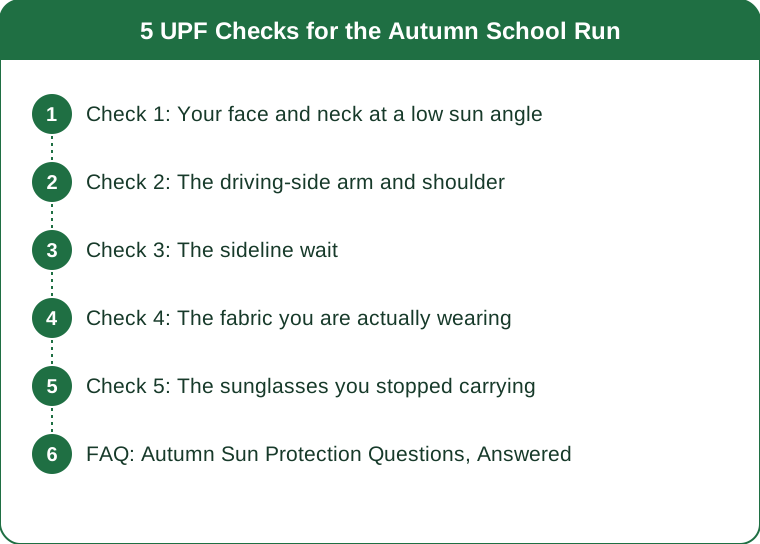
Five quick checks, each of them a two-minute fix.

Check 1: Your face and neck at a low sun angle
In autumn the sun sits much lower, which changes the geometry of exposure completely. Summer sun comes from overhead and hits the top of your head and shoulders. Autumn sun comes in sideways and hits your face and the side of your neck directly.
This is why a wide-brimmed hat that worked in July does much less in October — a horizontal brim shades a vertical sun, not a horizontal one.
What to change: a cap with a deeper front peak, or better, a lightweight UPF neck gaiter you can pull up on the sunny side. The side of the neck and the jaw line are the areas that pick up the most low-angle exposure and the ones people never think about. If you only fix one thing on this list, this is it.
Check 2: The driving-side arm and shoulder
If part of the school run is in a car, the arm nearest the window takes a repeated, one-sided dose.
Standard side windows block UVB effectively but transmit a significant portion of UVA, which is the wavelength associated with photoaging and cumulative skin damage. Windscreens block far more of both. So the side glass is the problem, and it points at whichever arm sits beside it.
Over a school year of twice-daily journeys the asymmetry becomes genuinely visible — dermatologists describe the pattern often enough that it has a name in the literature.
What to change: a light UPF sleeve or a long-sleeved layer kept in the car for the sunny direction of the journey. Which side matters depends on your route and the time of day, and it is usually obvious once you notice which arm feels warm.
Check 3: The sideline wait
Pickup and after-school sport mean standing still, often in an open space, often facing the same direction for 30 to 60 minutes.
Standing still is different from walking. When you walk, exposure is distributed as your orientation changes. When you stand watching a pitch, one side of you faces the sun for the whole duration, and the low autumn angle means it is your face, neck, and one arm rather than the top of your head.
What to change: turn around occasionally, which sounds trivial and halves the one-sided dose. If you regularly wait in the same spot, keep a packable UPF layer in the bag — the check is whether you have something with you, not whether you own one at home.

Check 4: The fabric you are actually wearing
Autumn wardrobes look protective and often are not, in specific ways.
- A loose-knit sweater can have a low effective UPF. You can see the gaps if you hold it up to a light, and if light passes, so does UV.
- Stretched fabric protects less. A knit pulled taut across the shoulders has larger gaps than the same fabric relaxed — this is why fitted layers underperform their rating.
- Wet fabric protects less, which matters on a rainy walk more than people expect.
- A white cotton t-shirt is roughly UPF 5 to 7, far below what most people assume, and less when wet.
What to change: for the layer that will be your outermost on a sunny walk, favour a tighter weave or a rated UPF piece. Dark, dense, dry fabric is the practical rule, and it happens to describe most autumn outerwear already.
Check 5: The sunglasses you stopped carrying
Most people put sunglasses away when summer ends, and autumn is when the low sun angle makes them most necessary for the eyes.
A low sun sits directly in your line of sight for a good part of a morning or afternoon commute, and UV exposure to the eyes is associated with cataract and other ocular conditions over time. There is a practical safety element too — squinting into a low sun while crossing roads with children is its own problem.
What to change: keep a pair in the bag from September rather than the drawer. Look for a UV400 rating, which blocks essentially all UVA and UVB; the tint darkness is unrelated to UV protection, and a dark lens without UV filtering is worse than no lens because it dilates your pupil.
This is general information, not medical advice. Any changing mole or new skin lesion should be assessed by a doctor regardless of your sun habits.
FAQ: Autumn Sun Protection Questions, Answered
Is UV actually high enough in autumn to matter?
The UV index falls substantially from summer, and cumulative exposure is what drives photoaging and skin cancer risk. Short, frequent, unprotected exposures across a whole term add up, and the low sun angle concentrates them on the face and neck rather than distributing them.
Do I still need sunscreen if I am wearing UPF clothing?
For covered areas, no. For the face, ears, and hands, yes — those are the areas clothing does not reach, and they are also the ones getting the most low-angle exposure. Clothing plus sunscreen on the gaps is more reliable than sunscreen alone, because it does not depend on reapplication.
Does UPF clothing wear out?
Yes, gradually. Repeated washing, sun exposure, and stretching all reduce effectiveness over time, and a heavily faded, stretched garment does not perform at its label rating. A rough guide is a couple of seasons of regular use for a well-used piece.
TL;DR:
- Autumn sun comes in sideways, so face and neck take the dose that summer put on your head and shoulders.
- Car side windows transmit substantial UVA, which is why the driving-side arm shows asymmetric damage over a school year.
- Standing still on a sideline concentrates exposure on one side — turning around occasionally halves it.
- Loose knits, stretched fabric, and white cotton protect far less than people assume.
Put sunglasses and a light layer in the bag you already carry. That covers four of the five checks without changing anything else.
Keep Reading
This article is for general informational and styling purposes only. Fit, sizing, and product availability may vary.