Five Places UPF Clothing Fails in Autumn Sun
Quick Answer: UVA levels fall far less across the seasons than UVB does, and UVA is the wavelength most associated with skin ageing and it penetrates cloud and glass. Autumn also changes the geometry - a low sun angle puts light on the face, neck and hands rather than the shoulders, which is exactly where most UPF clothing does not cover. The five common gaps: the low-angle face and neck, the driving arm, high-altitude and reflective days, wet or stretched fabric, and washed-out old garments.
The shirt did its job all summer.
Then the angle of the sun changed by thirty degrees and the parts of you that are exposed changed with it.

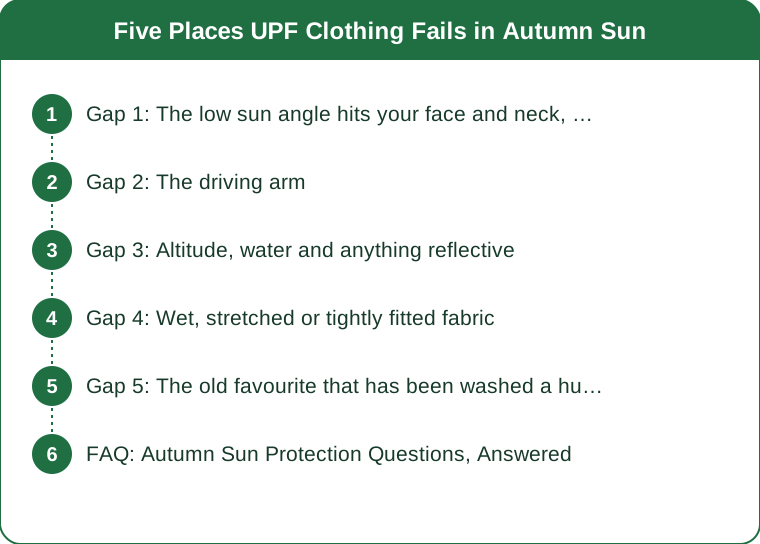
Gap 1: The low sun angle hits your face and neck, not your shoulders
Summer sun is overhead, so shoulders, upper back and the top of the head take the exposure - which is what most UPF clothing is designed around.
Autumn sun comes in at a low angle, putting light directly on the face, front of the neck and the chest for hours at a time.
A crew-neck UPF shirt covers none of that, which is why the coverage feels adequate and is not.
Morning and late-afternoon exposure rises in relative terms, since the sun spends more of the day at the angles that reach your face.
The fix is a brimmed hat and a collar, which is a far better autumn combination than the summer cap and crew neck.
And a quarter-zip or a shirt with a stand collar covers the front of the neck, which is one of the most commonly under-protected areas year round.
Gap 2: The driving arm
Standard car window glass blocks most UVB and only a portion of UVA, so the arm resting on the door in the sun is still receiving exposure.
Autumn driving happens with a low sun straight through the side window, which is a different geometry from the summer overhead sun.
Longer commutes in the dark half of the year raise cumulative time in the car during daylight hours.
The asymmetry is well documented - dermatology literature includes striking cases of one-sided photoageing in long-distance drivers.
A light long-sleeve layer in the car solves it entirely and is easier than remembering sunscreen on one arm.
Windscreens are usually laminated and block far more UVA than side windows, which is why the effect shows on the side rather than the front.
Gap 3: Altitude, water and anything reflective
UV rises roughly 10 to 12 percent per thousand metres of elevation, so an autumn mountain day can deliver more UV than a summer day at sea level.
Snow reflects a large share of UV back at you, which means early-season snow at altitude effectively doubles exposure from below.
Water and wet sand reflect significantly too, so autumn paddling, fishing and coastal walking are higher-exposure than they feel.
Cool air removes the warning signal. Sunburn risk is judged by heat, and a cold bright day at altitude produces burns precisely because it does not feel hot.
Cloud is not protection. Thin and broken cloud transmits most UV, and some conditions scatter it to levels close to clear sky.
Which makes the UV index, not the temperature, the number worth checking - and it stays meaningful into autumn on clear days at altitude.

Gap 4: Wet, stretched or tightly fitted fabric
Wet fabric transmits more UV than dry fabric, in some cases losing a substantial share of its rated protection.
Stretched fabric opens the weave and lets more light through, which is why a tightly fitted UPF garment protects less than the same garment worn loose.
Autumn water sports keep fabric wet for long stretches while the air is cool enough that nobody thinks about sun.
Light-coloured thin fabrics lose the most when wet, and dark or specially treated ones lose the least.
A loose fit is genuinely better protection as well as more comfortable, which is a rare case where the two align.
And a rating printed on a label refers to the garment dry, new and unstretched, which is not usually the condition it is in.
Gap 5: The old favourite that has been washed a hundred times
UPF ratings degrade with wear. Fibres thin, weave loosens and any UV-absorbing treatment gradually washes out.
Stretched-out garments protect measurably less than they did when the weave was tight.
Chlorine and salt accelerate the breakdown, so swim-focused pieces age faster than land ones.
Held up to a bright light, a worn UPF garment shows how much passes through - it is a crude test and a genuinely informative one.
Two to three seasons of regular use is a realistic lifespan for a garment relied on for protection.
And a UV-protectant laundry additive can restore some protection to ordinary clothing, which is a low-cost option worth knowing about.
This is general information, not medical advice.
FAQ: Autumn Sun Protection Questions, Answered
Does UV really matter once summer ends?
UVB drops substantially with the season and the sun angle. UVA declines far less and is the wavelength most associated with photoageing, so autumn exposure still counts.
What UV index is worth protecting against?
A UV index of 3 or above is the usual threshold for protection, and clear autumn days regularly reach it, especially at altitude.
Is a UPF shirt better than sunscreen?
For the skin it covers, yes - it does not wear off, rub away or get applied unevenly. It just does not cover the face, neck and hands, which is where autumn exposure lands.
Can I wash UPF clothing normally?
Cold, gentle, no fabric softener, air dried. Heat and harsh detergents degrade both the fibres and any treatment.
Does colour matter?
Darker and more saturated colours generally absorb more UV than pale ones at the same weave, though weave density and any treatment matter more.
What about car windows?
Side windows typically block most UVB and only a portion of UVA. A sleeve or a UV-filtering film addresses it.
This is general information, not medical advice.
TL;DR:
- UVA barely drops with the season and penetrates cloud and glass - autumn exposure is real.
- Low sun angle moves exposure to the face, neck and chest, where UPF shirts do not cover - use a brim and a collar.
- The driving arm gets meaningful exposure through side glass; a light sleeve solves it.
- Altitude, snow and water push UV up while cool air removes the warning signal - check the index, not the temperature.
- Wet, stretched and heavily washed fabric protects far less than the label says.
The sun did not go away. It just changed the angle it comes at you from.
Keep Reading
This article is for general informational and styling purposes only. Fit, sizing, and product availability may vary.