5 Sun Gaps Hiding in an Ordinary Commute
Quick Answer: Cumulative incidental exposure — commuting, waiting, walking between buildings — adds up to far more annual UV than holidays do for most people, and it is almost entirely unprotected. Car side windows block most UVB but transmit a large share of UVA, platform waits happen at the brightest hours, and autumn sun feels mild while UVA levels stay meaningful. A UPF layer that lives in the bag solves it without needing a decision every morning.
Five places it hides, and what to do about each.

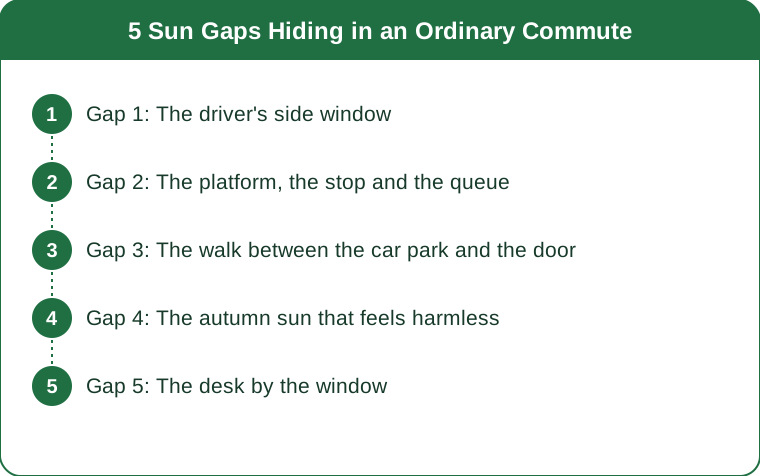
Gap 1: The driver’s side window
Windscreens are laminated and block the great majority of UVA. Side and rear windows are usually tempered rather than laminated, and plain tempered glass transmits a substantial fraction of UVA through.
This is why sun damage patterns are asymmetrical in drivers. Dermatology literature has documented consistently more photoaging on the window side of the face and the corresponding forearm in people who drive a lot.
A twenty-five minute commute twice a day is over four hours a week of one-sided exposure, every week of the year, which is more hours than most people spend on a beach in a summer.
What to wear: a light long-sleeve UPF layer that lives in the car rather than in the wardrobe. The decision has to be already made, or it does not happen.
Aftermarket UVA-filtering window film is the other option, and it is legal in many places for rear windows and restricted for the driver’s window. Check local rules before buying.
A visor does very little for the arm, which is usually the most exposed surface in the car.
Gap 2: The platform, the stop and the queue
Waiting happens at fixed times, and those times are often the brightest ones. A commute is scheduled around work, not around the UV index.
Open platforms and bus stops offer very little shade and often sit beside reflective surfaces — glass buildings, pale concrete, wet ground — which add reflected UV on top of direct.
Five to ten minutes twice a day sounds trivial and it is roughly an hour a week of high-index exposure to the face, neck and hands.
What to wear: the highest-value single item here is a wide-brim or long-billed hat, because the face and neck are the exposed surfaces while standing.
Position matters as much as clothing. Standing on the shaded side of a shelter rather than the sunny end is free and cuts direct exposure substantially.
And hands are almost never protected. They hold the phone, they face upward, and they show cumulative damage earlier than almost anywhere else on the body.

Gap 3: The walk between the car park and the door
Short exposures are dismissed because each one is short. Three minutes here, four minutes there, five days a week, fifty weeks a year is fifteen or more hours.
They cluster around the middle of the day. Lunch runs, coffee walks and errands happen when the index is highest, which is precisely why they matter more than their length suggests.
Nobody applies sunscreen for a three minute walk, and reapplying every two hours through a working day is not realistic for most people.
What to wear: this is the clearest case for clothing over cream. A UPF 50 layer works for the whole day without reapplication and without a decision each time.
A light shirt left over the back of the office chair removes the friction entirely. The item you have to fetch is the item you skip.
Shoulders and the upper back are the usual casualties, particularly in warm weather when the outer layer gets left behind.
Gap 4: The autumn sun that feels harmless
Lower temperature is not lower UV. The sensation of warmth comes from infrared, which drops off quickly in autumn; UVA declines far more gradually.
The sun sits lower in the sky from September onwards, which means it comes in through side windows and at eye and face level rather than from overhead.
Which is exactly why autumn is the season of the unnoticed exposure. Nobody thinks about sun protection in a jacket, and the low angle is hitting the face directly for the whole commute.
What to wear: sunglasses become more important, not less, in autumn, because the low angle puts the sun straight into the field of view.
A collared layer earns its place from September. The back of the neck is exposed when the sun is high and the front of the neck when it is low.
UV index still reaches meaningful levels on clear autumn days in most temperate regions, and cloud cover reduces UV far less than it reduces brightness.
Gap 5: The desk by the window
Office glass has the same property as car side glass. Most standard window glass blocks UVB effectively and lets a substantial proportion of UVA through.
Sitting in the same seat for years produces the same asymmetry drivers get, on whichever side faces the glass.
Modern coated and laminated glazing is much better, but there is no way to tell by looking, and older buildings frequently have plain glass.
What to wear: a light layer over the window-side arm, or simply moving the desk ninety degrees, which is free and permanent.
A blind used in the afternoon does double duty for screen glare and for UVA, and glare is the complaint that actually gets people to use it.
And this is the one people are most sceptical of, which is fair — the exposure is lower than outdoors. It is also eight hours a day, five days a week, for years, and cumulative dose is the whole point.
This is general information, not medical advice. Any new, changing or non-healing mark on the skin should be checked by a doctor.
TL;DR:
- Incidental exposure from commuting and desk work outweighs holiday exposure for most people.
- Car side windows and standard office glass transmit substantial UVA even when they block UVB.
- Autumn sun feels mild and arrives at face level, which makes it easier to ignore and easy to underestimate.
- Clothing beats cream for daily gaps because it needs no reapplication and no decision.
Leave the layer in the car and on the back of the chair. Protection you have to remember is protection you will skip.
Keep Reading
This article is for general informational and styling purposes only. Fit, sizing, and product availability may vary.