5 UPF Pieces That Earn Their Place in a September Wardrobe
Quick Answer: UV levels in early autumn remain meaningful, particularly in the middle of the day and at altitude, but the cues that prompt protection - heat, glare, obvious summer - disappear. Clothing keeps working regardless of temperature and needs no reapplication. These five pieces cover the exposures that persist into September. Cooler air does not mean lower UV.
The heat is what makes people think about sun.
The sun is still there when the heat leaves, which is exactly why September burns catch people off guard.

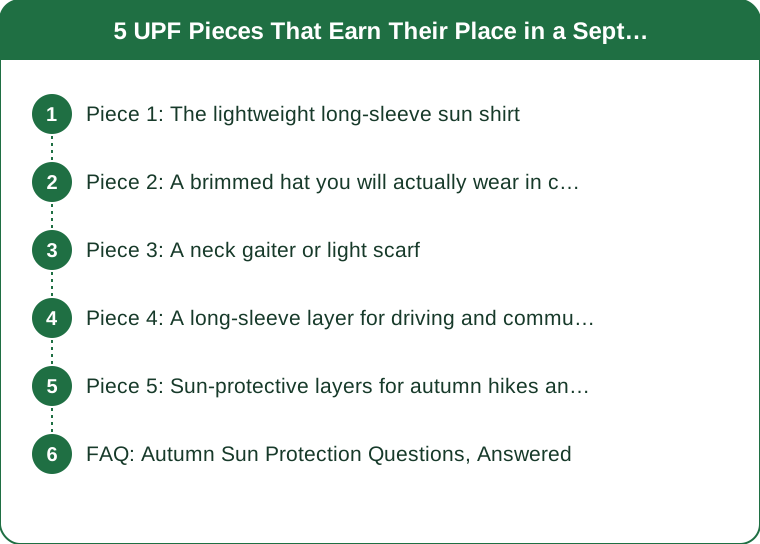
Piece 1: The lightweight long-sleeve sun shirt
The single most useful garment for the season, and the one people stop wearing first.
A long-sleeve UPF shirt covers the two areas that stay exposed longest into autumn - forearms and the back of the neck. Both are high-exposure zones that nobody reapplies sunscreen to after morning.
In September it stops being a cooling garment and starts being a comfortable one. The same shirt that felt like a compromise in August is simply pleasant in cooler air, which is why it gets more wear now than it did in July.
Look for a shirt that stays loose across the shoulders. Fabric stretched tight over skin lets more UV through, because stretching opens the weave. A relaxed fit protects better than a fitted one in the same fabric - a fact that surprises most people.
A collar you can turn up covers the back of the neck without a separate item, which matters when you are walking away from low autumn sun for an hour. The neck is the most commonly missed area on any walk with a consistent direction.
Piece 2: A brimmed hat you will actually wear in cool weather
The summer straw hat gets put away, and nothing replaces it.
A brim shades the face, ears, and part of the neck simultaneously - and it does so without needing reapplication or being sweated off. It covers the areas where sun damage is most cumulative and most visible over decades.
Autumn sun sits lower in the sky, which changes what a brim does. Low-angle light comes in under a brim rather than down over it, so a wider brim earns its width more in September than in June. The low angle is why people burn on faces in autumn despite wearing a hat.
Choose a hat rated for cooler weather so it stays in rotation. A packable canvas or technical hat in a darker colour reads as an autumn item rather than a beach one. The hat you wear beats the hat that protects better and lives in a cupboard.
Check that it is opaque. Loosely woven straw hats let a surprising amount of light through - hold it up to a bright window and see. If you can see the sky through it, so can your face.
Piece 3: A neck gaiter or light scarf
The most overlooked item, protecting the most reliably missed area.
The back of the neck is exposed on every walk, run, and ride and is almost never covered by sunscreen after the initial application. It is also awkward to reach, which is why the coverage there is so poor for so many people.
A light gaiter solves it without any decision-making. Pull it up and the area is covered continuously for hours, regardless of sweat, wind, or how long you are out. No reapplication, no missed spots.
In autumn it does double duty. The same piece that blocks UV blocks wind on a cool morning, which means it stays with you rather than being packed away. Dual purpose is why this one survives the season change when other sun items do not.
Darker colours generally offer more protection than very light ones at the same fabric weight, because more of the light is absorbed rather than transmitted. A dark gaiter is a better performer, which conveniently matches the season.

Piece 4: A long-sleeve layer for driving and commuting
The exposure nobody counts, happening five days a week.
Car side windows block substantially less UV than windscreens do. The result is consistent, asymmetric exposure to whichever arm sits by the window - and it accumulates over years of commuting rather than over one afternoon.
This exposure does not stop in autumn. The commute continues, the window stays where it is, and the only thing that changes is that nobody thinks about sun protection any more. September through November is unprotected driving season.
A light sleeve layer kept in the car solves it permanently. Not a decision to make each morning - a garment that lives there. Removing the decision is what makes it work, which is true of nearly every protective habit.
Look for something you can wear over office clothes without it looking like sportswear. A lightweight overshirt or cardigan-weight knit in a tight weave does the job and does not need to announce itself.
Piece 5: Sun-protective layers for autumn hikes and altitude
The season when the exposure risk actually goes up rather than down.
UV intensity increases with altitude, and autumn is peak hiking season for a lot of people. A cool day at elevation delivers considerably more UV than a warm day at sea level, and the temperature gives you no warning at all.
Reflected light adds to the direct exposure. Water, light rock, and later in the season snow all bounce UV upward onto areas that direct sunlight never reaches - under the chin, the underside of the nose, the ears. Reflection is why hikers burn in unexpected places.
Layers that cover while breathing well are the practical answer. You are working hard in cool air, so a garment that protects but traps heat gets removed within twenty minutes. The piece that stays on is the piece that works.
Wet fabric offers less protection than dry. Sweat-soaked fabric transmits more UV than the same fabric dry, so a shirt that is soaked through is doing less than its label suggests. On a hard hike, this is a real effect and an argument for fabric that moves moisture rather than holding it. If you notice a mole or patch of skin changing in size, shape, or colour, get it looked at - this is general information, not medical advice.

FAQ: Autumn Sun Protection Questions, Answered
Does UV really matter once it gets cold?
Temperature and UV are not connected - UV depends on sun angle, altitude, cloud, and reflection, none of which track how warm it feels. Cool, bright autumn days can deliver meaningful UV, and they remove every cue that would normally prompt protection.
Do I still need sunscreen if I am wearing UPF clothing?
For the areas the clothing covers, generally no - which is the main advantage. Face, ears, hands, and the back of the neck still need it, since those are what remains exposed.
Does UPF clothing lose effectiveness over time?
It does gradually, through washing, stretching, and wear that opens the weave. A visibly thinned or heavily stretched garment protects less than it did new, and holding it up to a bright light gives you a rough sense of where it stands.
TL;DR:
- UV does not track temperature - September delivers real exposure with none of the usual warning cues.
- A loose long-sleeve shirt protects better than a tight one in the same fabric, because stretching opens the weave.
- Low autumn sun comes in under a brim, so wider brims earn their width more now than in midsummer.
- Driving exposure continues all year - a sleeve layer that lives in the car removes the daily decision.
- Altitude and reflected light raise the risk on autumn hikes, and wet fabric protects less than dry.
Pick one piece to keep in rotation past Labor Day - the long-sleeve shirt or the car layer. One item that stays out beats five that go into storage.
Keep Reading
This article is for general informational and styling purposes only. Fit, sizing, and product availability may vary.