How Much Sun Does a Regular T-Shirt Actually Block?
Quick Answer: A typical white cotton t-shirt provides roughly UPF 5 to 7 — meaning about one-fifth of UV still reaches your skin — and it drops to around UPF 3 when wet or stretched. Dark, densely woven synthetics do far better, and denim is practically a wall. A UPF-rated garment guarantees tested protection of 30 to 50+, which matters for long outdoor hours, water days, and anyone burning through their shirt in late-summer sun. For a 20-minute errand, your closet is fine. For a whole afternoon outside, it probably is not.
If you can see light through it, UV is taking the same route.

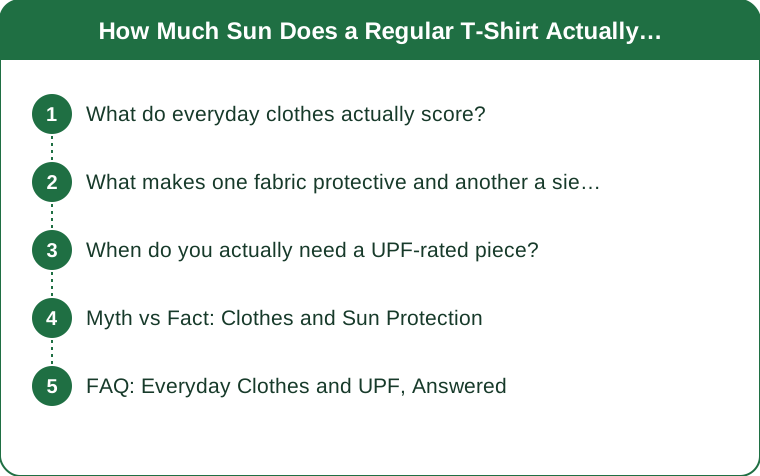
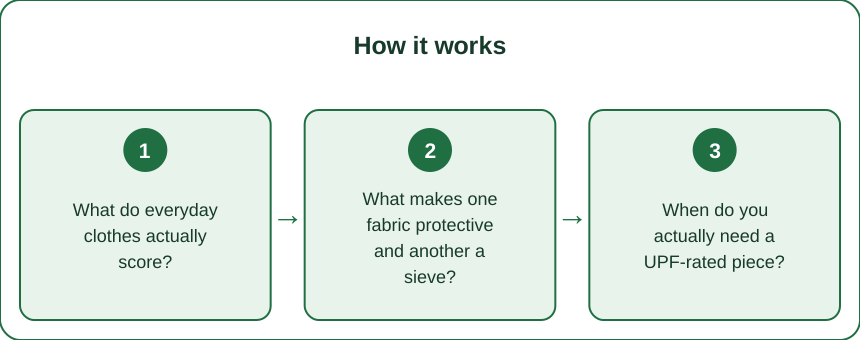
What do everyday clothes actually score?
Lower than almost everyone assumes, with a few surprise champions.
UPF works like SPF for fabric: UPF 5 lets about one-fifth of UV through, UPF 50 lets through about one-fiftieth. The difference between those numbers over a long afternoon is the difference between protected skin and a burn with a shirt on.
Rough real-world territory for common items:
A white cotton tee: around UPF 5 to 7. Thin, light-colored, and loosely knit is the worst combination, and it describes most summer t-shirts exactly.
The same tee wet: around UPF 3. Water fills the gaps in the weave and reduces scattering, so the soaked shirt you swim in protects least exactly when exposure is highest.
A stretched thin knit: meaningfully less than it measures relaxed, because stretch opens the spaces between yarns. A snug old tee across the shoulders is thinner armor than it looks.
A dark synthetic athletic top: often UPF 15 to 30+, thanks to dye, fiber type, and tighter knit — the quiet overachiever in most closets.
Denim: effectively total protection. Dense weave plus heavy dye makes jeans one of the most protective everyday fabrics ever made; nobody burns through denim.
The burn map tells the story. Late-summer burns through clothing show up on shoulders and upper back — the zones where a thin tee stretches tight and takes hours of high-angle sun. The shirt was real; the protection was not.
What makes one fabric protective and another a sieve?
Five variables, and you can read most of them by eye and hand.
Weave density is the biggest. UV mostly passes through the gaps between yarns, not through the fibers. Hold the garment up to a bright light: every point of light you see is a UV route. A fabric you cannot see light through is doing serious work.
Fiber type matters more than expected. Polyester and nylon absorb UV better than bleached cotton, which is comparatively transparent to it. This is why a thin synthetic top can outperform a heavier cotton one.
Color counts. Dyes absorb UV, and darker, more saturated colors absorb more. A navy tee genuinely protects better than the same tee in white — one of the few places the intuitive summer answer, light colors, is the wrong one for skin.
Weight and thickness stack the odds, simply by putting more material in the way.
Condition undoes all of it. Wet, stretched, or worn-thin fabric loses a large share of its protection. The favorite five-summer-old shirt is the least protective version of itself.
What a UPF label adds is a guarantee. A rated garment has been tested to a standard — UPF 30 blocks about 97 percent of UV, UPF 50 about 98 percent — and rated pieces are cut and constructed so the rating survives real wear. The label is not magic fabric; it is removed uncertainty, which is exactly what you want when the exposure is long.

When do you actually need a UPF-rated piece?
When time, water, or skin raises the stakes. Otherwise your closet covers you.
Short, dry, incidental exposure: regular clothes are fine. A commute, errands, a walk to lunch — a normal shirt plus sunscreen on the exposed bits handles it without ceremony.
Long outdoor hours are the first upgrade trigger. A full afternoon at a tournament, a day of yard work, a long hike: UPF 5 leaking one-fifth of UV for five hours adds up to real dose. Duration converts a small leak into a sunburn.
Water days are the second. Swimming turns a cotton cover-up into UPF 3, while a rated rash guard keeps its number wet. For pool afternoons and beach weekends — and for kids who will not hold still for reapplication — a UPF swim shirt replaces the least reliable sunscreen zone on the body: the upper back.
High-reflection settings are the third. Water, sand, and pale pavement bounce UV up under brims and through thin fabric from angles sunscreen routines miss.
Skin that raises the stakes is the fourth: photosensitizing medications, very fair skin, a history of skin cancer, or a dermatologist who has already said the word. For those cases, rated clothing is the low-effort backbone and sunscreen is the trim.
Late summer deserves respect on its own. August UV in most of the US still runs high at midday even as vacations wind down; the exposure season outlasts the caution season by about six weeks.
Build the small kit once: one UPF shirt or rash guard, one pair of UPF leggings or long shorts for field days, one real-brimmed hat. Those three cover the long-exposure days, and your regular closet handles everything else.
Myth vs Fact: Clothes and Sun Protection
Myth: Any shirt beats sunscreen. Fact: A dry, dense, dark shirt usually does. A thin wet white tee at UPF 3 loses to properly applied sunscreen. The honest ranking depends entirely on which shirt and whether it is wet.
Myth: White is the smart summer color for sun. Fact: White is cooler-feeling but less protective; dye absorbs UV, so darker versions of the same fabric block more. For pure protection, navy beats white every time.
Myth: UPF clothing is stiff, hot scuba gear. Fact: Modern rated fabrics are lightweight knits engineered for airflow — many UPF tops and leggings are indistinguishable from regular activewear except for the label and the missing burn.
Myth: If I don’t feel hot, I’m not getting UV. Fact: UV and heat are separate. A breezy 72-degree late-summer afternoon can carry a high UV index, and a thin shirt leaks the same fraction of it regardless of how pleasant the air feels.
Myth: UPF washes out after a few cycles. Fact: Protection woven into the fabric — density, fiber, dye — is permanent. Only spray-on or wash-in treatments fade, and rated garments relying on construction keep their number for the life of the fabric.
FAQ: Everyday Clothes and UPF, Answered
How can I estimate a shirt’s protection at home?
Hold it up to a bright light. Clearly visible pinpoints of light suggest single-digit UPF; a dense fabric showing almost none is doing far better. Add points for dark colors and synthetics, subtract for wet, stretched, or threadbare.
Is sunscreen under a thin shirt a reasonable fix?
Yes — sunscreen on shoulders and upper back before a thin-tee day patches the leak, though it needs the same reapplication as anywhere else. For water or all-day exposure, a rated garment is less maintenance and more reliable.
Do I need UPF clothing in fall too?
For long midday outdoor stretches at lower latitudes and on reflective settings like water, it still earns its place through September and beyond. The UV index on your phone, not the month, is the honest trigger.
Are UPF ratings on cheap garments trustworthy?
The rating standard is real, but enforcement varies. Established activewear and swim brands testing to the standard are generally reliable; a miracle rating on a see-through fabric is not. If light pours through it, no label makes that true.
TL;DR:
- A typical white cotton tee runs about UPF 5 to 7 and drops near 3 when wet — one-fifth of UV gets through dry, a third wet.
- Density, fiber, and color decide protection: dark, tight synthetics and denim do well; thin, light, stretched cotton does not.
- Regular clothes cover short dry errands; long outdoor days, water, reflection, and sensitive skin justify rated UPF 30 to 50 pieces.
- Late-summer UV is still high at midday — check the UV index, not the calendar or the temperature.
Do the hold-it-to-the-light test on your three most-worn summer shirts tonight. You will know in ten seconds which one needs backup.
See It in Motion
Seen here: High Waist Yoga Leggings with Side Pockets — shop it on bubblelime.com
Keep Reading
This article is for general informational and styling purposes only. Fit, sizing, and product availability may vary.